

Inspired by the persistent misconceptions we see about Scrum Masters, and borrowing from Eminem, we felt compelled to ask: will the real Scrum Master please stand up?
This post addresses a troubling trend: the persistent misunderstanding of what a Scrum Master is and does. Scrum has been around for over 25 years, yet many people still have not grasped its core purpose. They continue to treat the Scrum Master as a rebranded project manager.
We regularly come across misleading LinkedIn posts that portray Scrum as just another project management framework. More alarmingly, those posts are promoting Scrum courses. One brazenly asserted: "Discover how Scrum can empower you to become a master of project management." That perpetuates the feature factory, mini-waterfall mindset and undermines the fundamental purpose, values and principles of Agile and Scrum.
Here we shed light on the true essence of a Scrum Master and clear up the misconception.
Contrary to popular belief, Scrum Master is an accountability, not a role, within the Scrum Team. The Scrum Master is a guiding mirror, reflecting not what the team wants to see but what it needs to confront: its untapped potential for business agility, self-organisation and empirical decision-making.
If you have ever felt your organisation is not genuinely practising Scrum, or that your Scrum Master is not fulfilling the accountability, you are not alone. Let's clear the air and help the real Scrum Master stand up.
Understanding the Scrum Master accountability
Before answering the question, a quick recap on what Scrum is. Scrum is a lightweight framework of three accountabilities, five events and three artefacts. One of the accountabilities is the Scrum Master.
Before the 2020 update to the Scrum Guide these were called roles. The term changed to accountabilities to remove the misunderstanding that one person could not hold more than one. So can you hold more than one? More on that later.
The Scrum Guide defines the accountability like this:
"The Scrum Master is accountable for establishing Scrum as defined in the Scrum Guide. They do this by helping everyone understand Scrum theory and practice, both within the Scrum Team and the organization."
"The Scrum Master is accountable for the Scrum Team's effectiveness. They do this by enabling the Scrum Team to improve its practices within the Scrum framework."
The Scrum Master is the catalyst that propels the team towards excellence, fuelled by Scrum's essence of embracing change, fostering learning and nurturing continuous growth.
A Scrum Master is not a project manager
The most pervasive misunderstanding is that a Scrum Master is simply a project manager by another name. It is misleading, and it undermines the essence of Scrum and the unique value a Scrum Master brings.
The Scrum Master is not a project manager in agile clothing. They do not manage budgets, schedules or resources. Their focus is not delivering a project on time and in scope, but building an environment where the Scrum Team can thrive and deliver value iteratively and incrementally.
Scrum Master vs project manager
| Aspect | Scrum Master | Project manager |
|---|---|---|
| Accountability | Fosters Scrum adoption, team understanding and continuous improvement within the Scrum framework | Manages the project's scope, schedule and budget to meet project objectives |
| Decision-making | Empowers the team to self-manage and encourages data-driven decisions | Makes decisions, delegates tasks and oversees execution |
| Approach | Guides the team to embrace empiricism and value-driven outcomes, and cultivates continuous improvement | Directs, manages resources and applies established project management methodologies |
| Leadership style | Servant leadership | Command and control |
| Change | Embraces change and uncertainty | Works to a defined scope and minimises deviation from the plan |
| Adaptation | Emphasises adaptability and flexibility to reach the desired outcome | Follows a predefined plan to meet predetermined success criteria |
In line with the Scrum Guide, the Scrum Master's accountability extends to helping everyone, inside the Scrum Team and across the organisation, understand the theory and practice of Scrum. They do this by:
- Educating and coaching. Helping team members and stakeholders understand the principles and values that underpin Scrum. That goes beyond rule-following into the philosophy of agile ways of working.
- Facilitating Scrum events, if needed. Contrary to another common misconception, the Scrum Master facilitates Sprint Planning, the Daily Scrum or the Sprint Retrospective only when needed. Their job is to make sure the events are effective and true to the spirit of Scrum, so the team can inspect and adapt.
- Removing impediments. Where a project manager tries to control external variables to stick to a plan, the Scrum Master removes the obstacles that stop the team delivering value.
- Promoting self-organisation. Empowering the team to take ownership of its work, rather than dictating how things should be done.
The Scrum Master upholds the integrity of the framework and supports the team's journey towards continuous improvement and high performance. They do not serve the project. They serve the team, and through the team, the organisation's pursuit of agility and excellence.
Can you hold more than one accountability?
The short answer is yes, but not without challenges, and it depends heavily on context. Picture a Viking longboat navigating treacherous waters.
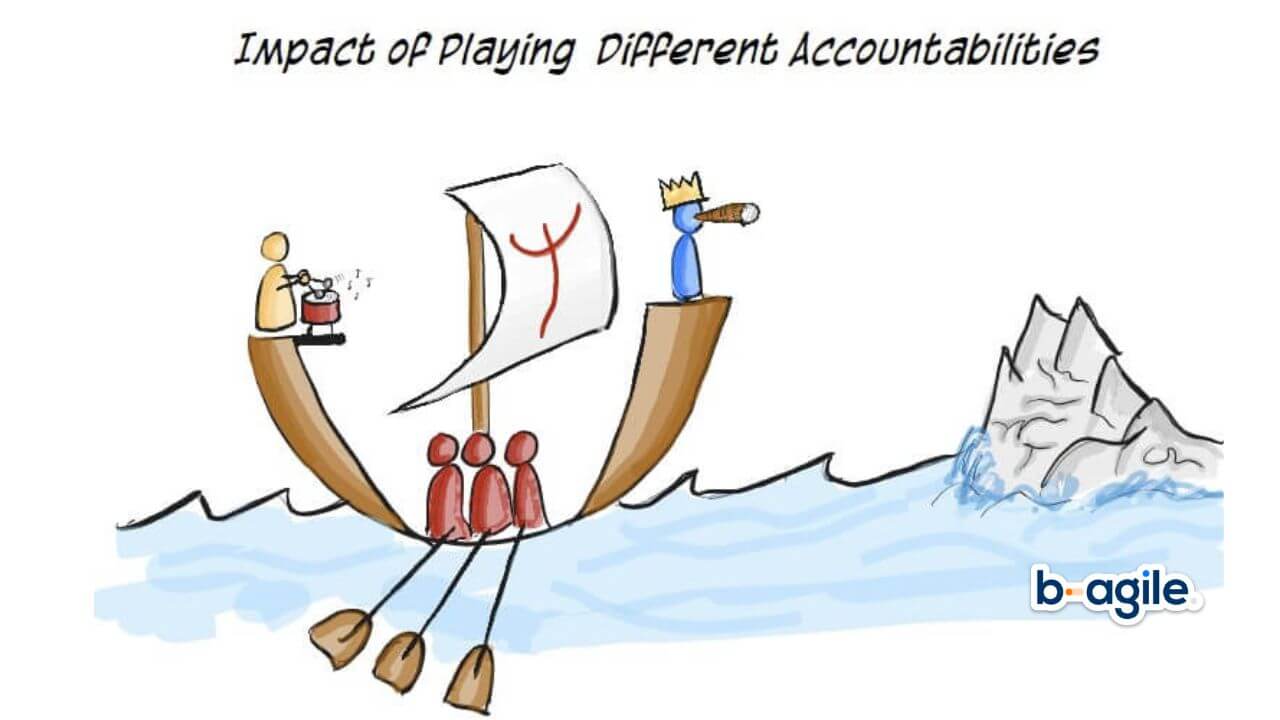
- Product Owner. At the front, focused on maximising value and plotting the journey ahead.
- Developers. In the middle, the heart of delivering value through completed work.
- Scrum Master. At the back, supporting the Developers, the Product Owner and the wider organisation.
The navigational dilemma: Product Owner and Scrum Master
If you lean towards the Product Owner accountability, who supports the Developers and drives organisational change? If you lean towards the Scrum Master, who is at the front guiding the ship to maximise value?
A different set of challenges: Scrum Master and Developer
The Scrum Master, as part of the team, can watch both the Product Owner and the Developers. But if they are engrossed in development, who focuses on the wider organisation? How well this combination works usually depends on the team's maturity and the nature of the work.
Taking on multiple accountabilities is a balancing act that can dilute the effectiveness of each. For a team exercise on this, see Know your Scrum accountabilities.
The true essence of a Scrum Master
Here are the core attributes, tools and philosophies that define a Scrum Master: a catalyst for change, a servant leader, and the champion and guardian of the Scrum values and principles.
Characteristics of an effective Scrum Master
Great Scrum mastery is situational, but some traits are common:
- Servant leadership
- Influence without authority
- A coaching mindset
- The courage to challenge the status quo
By putting the team's needs first and helping unlock its potential, a Scrum Master enables amazing outcomes.
Embracing servant leadership
The Scrum Master exemplifies servant leadership, focused on the team's growth and wellbeing rather than exercising authority for its own sake.
From coordination to coaching. A Scrum Master moves away from traditional management and empowers the team instead:
| Move away from | Move towards |
|---|---|
| Coordinating individuals | Coaching people in Scrum |
| Providing answers | Enabling self-management |
| Investing in outputs | Helping manage the Product Backlog |
| Deadlines | Focusing on flow and value |
| Prescribing solutions | Improving the Definition of Done |
| Fixing problems | Guiding the team to discover what works |
The Scrum Master is accountable for:
- Helping the team understand Scrum theory and its underlying principles.
- Enabling the team to become more effective, through continuous improvement, removing impediments, and supporting self-management and cross-functionality.
While the Scrum Master enables effective Scrum and team growth, the Product Owner is accountable for maximising product value. For more on that, read Unmasking the Product Owner accountability.
The six stances of a Scrum Master
Scrum Masters do not follow a one-size-fits-all method. They have a variety of interventions and behavioural stances, each suited to a situation. The six stances are a heuristic for the Scrum Master's decision-making. There is no universally right choice, only what the Scrum Master judges most effective in context.
| Stance | Description |
|---|---|
| The facilitator | Helps the team reach consensus in discussions |
| The coach | Helps the team improve its practices and behaviours |
| The servant leader | Serves the team by removing impediments |
| The mentor | Provides guidance based on experience |
| The teacher | Educates the team on the Scrum principles |
| The change agent | Drives change across the organisation |
For a deeper look at the stances and how to apply them, Barry Overeem's The 6 stances of a Scrum Master is essential reading. You can see the stances in action in the real-world scenario in Where to start with Scrum? Is value stream mapping your answer?
Living the Scrum values
The Scrum values of courage, focus, commitment, respect and openness are the lifeblood of the framework, and something the Scrum Master can fall back on to help the team. If a team is missing a Sprint Goal or a Product Goal, for example, it may be a sign of a lack of focus and commitment. The Scrum Master can use the values as a guide to help the team realign.
Essential Scrum Master mottos
Scrum Masters live by mottos and heuristics such as:
- Let the team decide
- Reveal, don't resolve
- Ask, don't tell
- Pull, not push
- The art of the possible
- Curiosity with positive intent
These simple mantras help them avoid prescribing solutions and instead shine a light for the team to inspect and adapt.
The Scrum Master's essential toolkit
The toolkit is grounded in two core tools:
- Empiricism. Used to bring issues to light and guide the team in solving them. A development bottleneck, for instance, is made visible so the team can inspect and adapt.
- Self-management. Empowers the team to own its work and overcome its challenges. When an obstacle arises, the Scrum Master facilitates a discussion for the team to find its own solution.
For an example of using empiricism to help a team, read Definition of Done: where to start.
Complementary practices
Beyond empiricism and self-management, Scrum Masters add complementary practices to the toolbox. They are not part of Scrum, but they help the team's effectiveness and maximise the benefits of Scrum:
- Product ownership practices. Helping the Product Owner maximise value through goal-setting, vision alignment and backlog management.
- Facilitation techniques. Essential for running effective Scrum events and resolving conflict.
- Technical practices. Helping the Developers meet the Definition of Done and deliver high quality.
- Flow practices. Optimising the flow of work, improving transparency and enabling better conversations about progress.
- And many more. The toolkit keeps expanding.
As the saying goes, the Scrum Master reveals but does not resolve. The ultimate goal is collective learning and improvement that unlocks the team's full potential.
A final thought on what a Scrum Master is
It is time to dispel the myths and embrace the true accountability of a Scrum Master. They are not traditional managers, project administrators or Jira experts. They are catalysts for change, guiding mirrors that illuminate the path to business agility, self-organisation and value-driven outcomes.
They do this by embracing the Scrum framework and its pillars of empiricism. They use self-organisation, the Scrum values, the stances and the mottos to help the team inspect, adapt and improve. Their core duty is to uphold the framework, promote continuous improvement and empower the team to unlock its potential.
If this helped you understand the Scrum Master accountability, please share it. It might be the catalyst for someone's agile journey. To deepen your own Scrum Master skills, our Professional Scrum Master course is where to start.
Go deeper
Professional Scrum Master - AI Essentials (PSM-AI)
Put this into practice with the course that covers it in depth.
View the course