

As a Scrum.org trainer I hear the same misconceptions about Agile and Scrum again and again. They surface whenever we explore what people currently understand the two words to mean. Here are a few of the red flags, by no means an exhaustive list.
About Agile:
- Agile is a methodology.
- A focus on agile tools and practices with no understanding of the why, the mindset, or business agility.
- Customer collaboration and feedback neglected.
- Self-organisation and cross-functional teams neglected.
- Agile means no planning and no documentation.
- Resistance to change, and clinging to the current process.
About Scrum:
- Scrum is a methodology.
- Scrum is an agile project management delivery system.
- Scrum is breaking work into small tasks so they get delivered faster.
- A focus on features delivered rather than value delivered: the feature factory.
- No valuable, usable, Done Increment at the end of each Sprint.
- No validation once an Increment is released to the market.
- No understanding of what the Sprint Review and Sprint Retrospective are for.
- Scrum only applies to software development.
These misconceptions show why it matters to understand Agile and Scrum beyond the surface practices. Agile is about business agility: the ability to adapt and respond to change so you deliver value in a fast-moving, customer-centric market. Without that, the essence of both Agile and Scrum stays out of reach.
In our experience these misunderstandings seriously limit the benefits teams get. This post clears up the most common ones and gives you enough of the core concepts to put them to rest. Let's start with Agile.
What is Agile?
Agile is a mindset, not a set of procedures or tools. In 2001 the Agile Manifesto for Software Development captured a new way of thinking in four values and twelve principles for delivering software better. Its roots are in software, but its values and principles have long since spread well beyond it.
At the heart of Agile is a value-driven approach with customer satisfaction front and centre. The aim is to deliver high-quality products or services to the market effectively, so you get feedback, and validation, from customers. Agile takes creating real value for customers seriously and aligns every effort with their needs.
The Agile Onion
To understand Agile and its real purpose, we find the Agile Onion useful. It is a visual that captures the essence of Agile: not tools or practices, but a deep shift in thinking and behaviour.
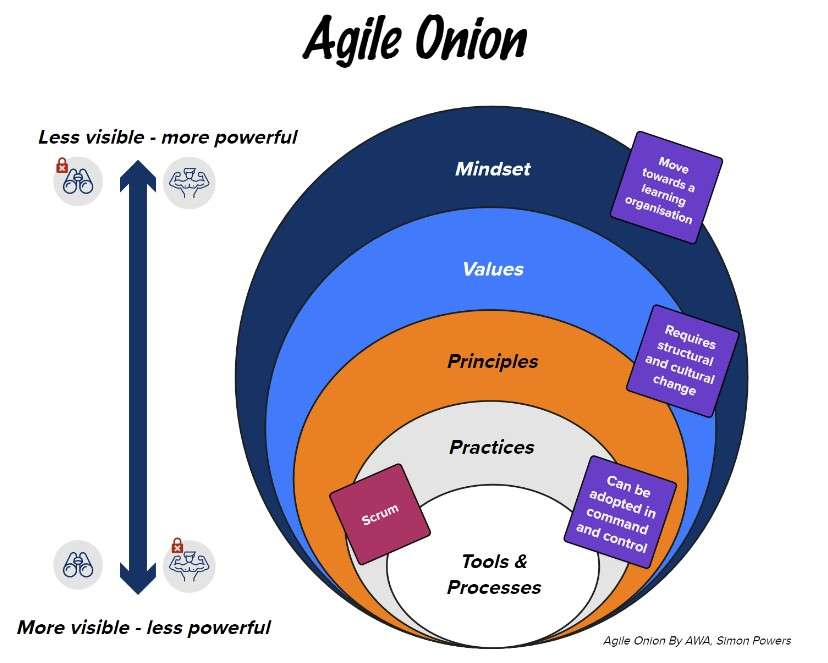
The onion has five connected layers:
- Tools and processes. The most visible and least influential layer: Jira, Azure DevOps, whiteboards, sticky notes.
- Practices. Frameworks and techniques such as Scrum, Kanban, XP and story mapping. Effective when they are aligned with the principles and values.
- Principles. The guidelines from the Agile Manifesto, emphasising collaboration, adaptability and frequent delivery.
- Values. The Agile values (individuals and interactions over processes and tools, working software over comprehensive documentation, customer collaboration over contract negotiation, responding to change over following a plan) and the Scrum values (commitment, courage, focus, openness and respect).
- Mindset. The core: adaptability, continuous learning, customer focus and responsiveness to change and opportunity. An experimental approach, fast feedback loops, and value delivered early and often.
The onion helps you look past the allure of tools and practices. They can be useful enablers, but the essence of Agile is in the outer layers, the principles and values that shape the mindset and drive lasting change. Start with values and principles and the mindset follows.
Agile misconceptions
The biggest misconception we hear is that Agile is a methodology or a project management approach. It is neither. It is a mindset, underpinned by values and principles, that shapes how we work and interact: product-oriented and outcome-driven rather than project-oriented and output-driven.
The agile mindset focuses on delivering value to customers, collaborating with stakeholders and embracing change. Scrum is one way to help teams put those values and principles into practice.
For more on why organisations struggle with this, read Why Agile fails.
Agile vs Waterfall
Waterfall follows a linear, sequential process where progress flows steadily downwards. Agile is iterative and incremental: requirements and solutions evolve through the collaboration of self-organising, cross-functional teams. Small experiments and frequent feedback loops let teams learn, adapt and deliver value continuously.
Agile is a speedboat, quick to change direction and seize an opportunity. Waterfall is an oil tanker: once the course is set, changing it is slow and hard.

If you lead teams and want to understand how agile leadership supports the shift, our Professional Agile Leadership Essentials course goes deeper. What you measure matters, and that is what really drives culture change in an organisation.
What is Scrum?
"Scrum is a lightweight framework that helps people, teams and organizations generate value through adaptive solutions for complex problems."
Scrum Guide 2020
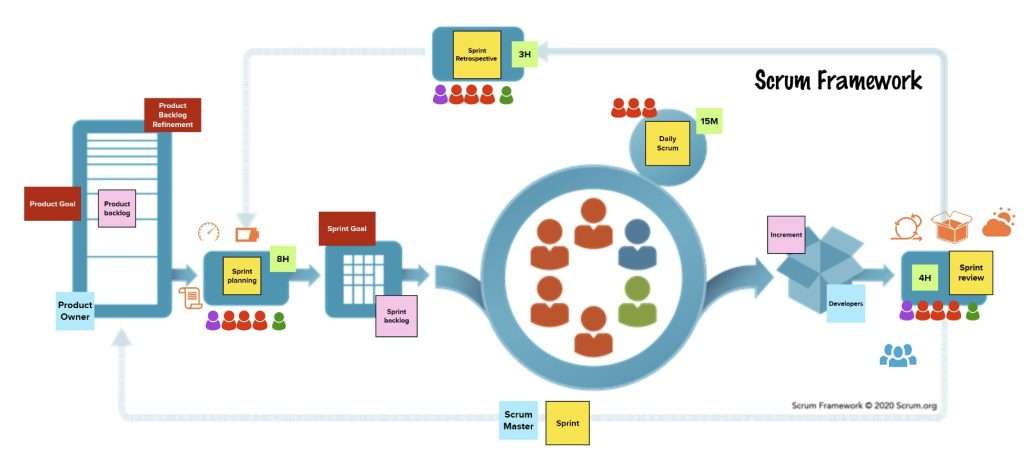
Scrum consists of eleven essential elements, the artefact commitments, and the rules that bind them, as set out in the Scrum Guide. The elements are grouped into accountabilities, artefacts and events:
Accountabilities: Product Owner, Scrum Master, Developers.
Artefacts: Product Backlog, Sprint Backlog, Increment.
Events: Sprint, Sprint Planning, Daily Scrum, Sprint Review, Sprint Retrospective.
Each artefact carries a commitment that provides focus, transparency and alignment: the Product Goal, the Sprint Goal and the Definition of Done.
The Scrum values of commitment, focus, openness, respect and courage underpin the framework. They shape the behaviour and mindset of the Scrum Team and promote collaboration, transparency and adaptability.
Scrum does not prescribe complementary practices. Teams add whatever techniques and methods suit their context.
Think of Scrum as the rules of the game, like football. Every football team plays differently, yet all of them play to the same rules. If you picked the ball up, ran with it and your team let you score, fine, but it is no longer football. Change the rules of Scrum, by dropping an event or an accountability, and fine, but stop calling it Scrum.
Scrum gives you the rules through a lightweight framework. Implement the framework as the Scrum Guide describes it, and what you do in the middle, the complementary practices you choose, is entirely up to you. Scrum gives you a foundation for handling complexity, embracing continuous improvement through empiricism, and achieving valuable outcomes. It is purposefully incomplete so you can be creative in how you play.
Scrum is more than its mechanics, though. It is a path to realising the Agile values and driving business agility. For the deeper purpose behind the rules, read What is Scrum? Uncovering its true essence.
Scrum misconceptions
Despite its popularity, misconceptions about Scrum persist. The most common is that Scrum is a methodology or a product management process. It is neither. It is a lightweight framework that helps you embrace empiricism and self-organisation.
Scrum does not promise a faster development cycle as its main goal. It is about empirical process control, continuous improvement and the ability to adapt to change. The real magic happens when a team fully embraces the Scrum values. They create an environment of collaboration, transparency and adaptability that makes teamwork genuinely rewarding and effective.
To understand Scrum well, read the Scrum Guide. Read it several times and analyse each section. It will give you a clear picture of how Professional Scrum should work.
The challenge of implementing Scrum
Delivering a Done Increment every Sprint is the biggest challenge for most teams, and the most important thing to get right, especially in software. The Scrum Guide stresses empiricism and the Definition of Done, but it does not tell you how to achieve a Done Increment. If you asked me to sum Scrum up in one thing, it would be a Done, valuable, usable Increment every Sprint. Yet so many so-called Scrum teams do not have one.
Getting there usually takes complementary practices that align with Scrum: continuous integration, test automation, code review, pair programming and other engineering practices that build in quality and enable frequent delivery of potentially shippable Increments.
How Scrum embodies the Agile principles and values
Scrum's events and accountabilities are designed to uphold the Agile principles and values. Embrace Scrum properly and you build a culture of collaboration, self-organisation, transparency and continuous improvement.
Continuous improvement is a good example. The Sprint Retrospective is a dedicated event for it: the Scrum Team reflects on its process, practices, tools and Definition of Done, identifies improvements and commits to making them in the next Sprint. That promotes learning, adaptation and relentless improvement.
Embrace Professional Scrum, use the events and accountabilities as intended, and you harness the Agile principles and values to deliver value more effectively, adapt to changing requirements, and keep improving your process and outcomes.
Agile and Scrum
Understanding the relationship
Agile is a way of working, with underlying values and principles, that promotes an iterative and incremental approach to product development. It values flexibility, collaboration and customer satisfaction through the continuous delivery of valuable solutions.
Scrum is a lightweight framework teams can implement. It brings together the three pillars of empiricism (transparency, inspection and adaptation), the Scrum values and self-organisation, so teams can keep delivering high-quality products in a fast-changing market.
Decisions in Scrum are based on observation and feedback, so teams keep improving. Scrum aligns with the Agile principles through iterative development, frequent inspection and continuous adaptation. It gives teams a framework for living the Agile values and delivering value incrementally.
Scrum is widely adopted, but it is not the only way to practise Agile. Kanban, Lean and Extreme Programming (XP) each have their own principles and practices, and all of them align with the agile principles and mindset.
Understanding the relationship between Agile and Scrum helps a team choose the right approach for its context. The key is to embrace the Agile principles and values whichever you choose.
Which came first: Scrum or Agile?
A trivial question, but it helps you appreciate the connection. Many assume Agile came first. Scrum, developed in 1995, predates the Agile Manifesto of 2001. Ken Schwaber and Jeff Sutherland, the creators of Scrum, were among the founding signatories of the manifesto.
Summary
Embracing the Agile mindset, values and principles is the key to unlocking the full potential of Scrum and to a successful agile transformation.
Agile and Scrum can be hard to navigate, but once the misconceptions are cleared away the fundamentals are straightforward. Agile is a mindset that shapes how we work. Understanding how Scrum relates to it helps you choose the right approach and build collaboration, flexibility and customer focus into product development.
To move towards an agile mindset, focus on:
- The Agile values and principles. Understand them as the Agile Manifesto sets them out. They are the foundation of the mindset.
- Clear goals. Goals aligned with the values and principles keep teams focused and motivated.
- Change and learning cycles. Treat change as an opportunity to learn. Work iteratively and incrementally so you can get feedback and adapt.
- Collaboration and teamwork. Cross-functional collaboration, knowledge sharing and collective ownership of what gets delivered.
- An open, learning culture. Encourage experimentation and continuous improvement. Value feedback, learn from failure, celebrate success.
Scrum can help you achieve some of these.
If you want help with your understanding of Scrum and Agile, our certified courses and agile coaching are built for exactly that. For leaders and managers, the Professional Agile Leadership Essentials course is the place to start.
Go deeper
Professional Agile Leadership Essentials (PAL-E)
Put this into practice with the course that covers it in depth.
View the course