

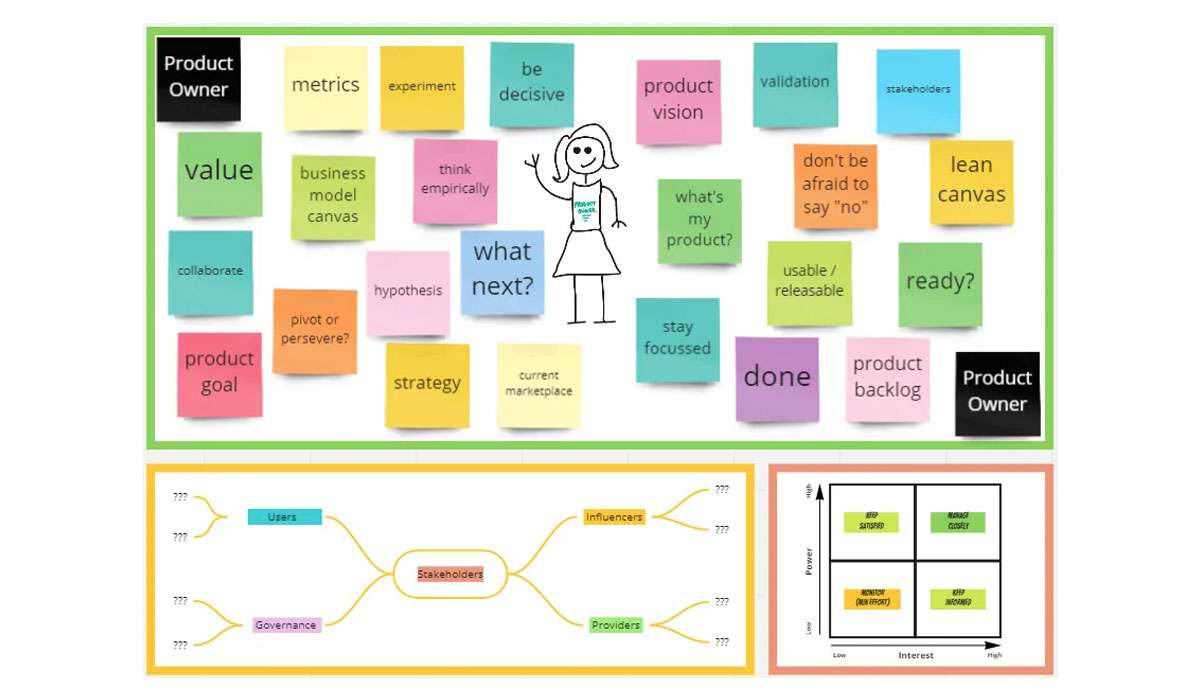
Following on from Considerations for a new Scrum Master, this post is for those just starting out as a Product Owner.
As before, the items are in no particular order. The aim is to outline the things worth considering as you begin your Product Owner journey.
- Know your product. Make sure you know just what your product is, what problems you are trying to solve, and for whom.
"A product is a vehicle to deliver value. It has a clear boundary, known stakeholders, well-defined users or customers. A product could be a service, a physical product, or something more abstract." The Scrum Guide 2020
- Generate a business model. Take time to explore the Business Model Canvas or the Lean Canvas, so the people around you begin to understand your product and its unique value proposition.
- Create and share your product vision.
- Your vision should inspire the people working towards that long-term goal.
- Keep it short, focused and to the point, so others understand and remember it.
- Explore the many online templates available to get you going.
- Pull others in to help you create it. You do not have to do this alone.
- Communicate and share the vision at every opportunity. As a minimum, think about the core Scrum events.
- Create a Product Goal.
- It is an intermediate goal, a step towards the longer-term vision.
- Make it measurable, otherwise how will you ever know you have achieved it?
- Make sure your Scrum Team and the wider organisation understand it.
- Remember the intent is to achieve or abandon a Product Goal before moving on to the next.
- Start to build your Product Backlog.
- Your active Product Goal belongs in the backlog, but not everything in the backlog has to relate directly to it.
- Get others involved, and consider a technique such as user story mapping to get started.
- Identify your key stakeholders. Run a brainstorming activity with everyone you think has an opinion, and build a stakeholder map:

Then place the stakeholders you have identified on a two-by-two power-interest grid, so you know how best to involve each of them:

- Make use of your Scrum Master. Scrum Masters are there to help you. Ask for their support with Product Backlog management and with conversations and collaboration with stakeholders, particularly facilitation.
- Make use of your Developers. Try not to spend all day, every day gathering requirements, uploading them into a web tool, adding as much detail as you can including acceptance criteria, and handing them off to the Developers. That is not a valuable use of your time, and it does not enable business agility. Get the rest of the Scrum Team to take more responsibility for Product Backlog management. Shared understanding, built through conversation and collaboration, is what matters most.
- Metrics, metrics, metrics.
- Consider which metrics make sense in your context. Without them, how do you know you are doing the right thing? How do you know it is valuable? How do you know when to try something different?
- Look at Evidence-Based Management and understand how the four key value areas relate to each other. Explore the candidate metrics you might use for your product, remembering it is not an exhaustive list.
- Experiment, experiment, experiment. Consider what experiments you could run to learn whether to pivot or persevere. Adopt the mindset and behaviours of an entrepreneur.
- Shorten the feedback loop. Shorter feedback loops accelerate learning. Until you release, everything is a hypothesis. You need to release in order to validate, and potentially realise, value.
- Keep learning. Scrum.org's Product Owner learning path is full of excellent material.
I hope you find these thoughts useful as you begin your Product Owner journey. Let me know what is missing and what else you would add for a new Product Owner.
If you would like to join a Professional Scrum Product Owner class, reach out to me at paulralton@bagile.co.uk or take a look at the course page. We run both public and private courses.
Go deeper
Professional Scrum Product Owner (PSPO)
Put this into practice with the course that covers it in depth.
View the course